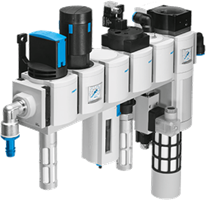
Which type of air preparation should you choose?
The right choice depends on your application and the required compressed air purity. Use the selection guide below as a starting point:
| Situation |
Recommended component |
| Basic compressed air cleaning |
Filter or water separator |
| Constant working pressure required |
Pressure regulator or filter regulator |
| Precise pressure per circuit |
Precision pressure regulator |
| Lubricating valves or cylinders |
Lubricator |
| Food processing or medical application |
Mist separator + oil-free filter |
| Sensitive measuring equipment |
Compressed air dryer + fine filter |
Note when selecting: always match the compressed air quality delivered by your compressor with the quality class required by your consumers. The difference determines which filtration steps are needed.
Compressed air purity according to ISO 8573-1:2010
ISO 8573-1:2010 is the international standard for compressed air purity in pneumatic systems. The standard has been mandatory for pneumatic automation since 2010 and defines maximum concentrations for three contamination categories:
- Solid particles — classified in classes 0 to 9 based on particle size and concentration
- Water — determined by pressure dew point or liquid water content (classes 0 to 9)
- Oil — total oil concentration in mg/m³ (classes 0 to 4)
A class designation looks like this: ISO 8573-1 class 1.4.1 — where each number indicates the class for particles, water and oil respectively.
How do you determine the correct purity class?
Ask yourself the following three questions for your installation:
- What purity class does your compressor deliver?
- What purity class do your consumers require — valves, cylinders, measuring equipment?
- What class does your end product or industry require (e.g. food, pharmaceuticals, automotive)?
The difference between the compressor output and the required quality determines which air preparation components you need to install in line. A filter combination consisting of a coarse filter, fine filter and activated carbon filter typically achieves class 1 for particles and oil.
Not sure about the correct classification for your application? Request technical advice — we help you select the right filter combination based on your compressor data and consumer requirements.
What happens with insufficient air preparation?
Every cubic metre of compressed air contains millions of contaminant particles, measurable amounts of moisture and oil residues, and in some environments even traces of heavy metals. If these are not removed before use, the following faults occur:
- Rapid wear of seals in valves and cylinders
- Clogged silencers due to oil and dirt build-up
- Oil deposits on solenoid valves that reduce switching speed
- Corrosion in pipes and fittings due to condensed moisture
The consequences for your installation:
- Lower machine availability due to unplanned failures
- Higher energy costs as a result of pressure losses and leakage
- Increased maintenance costs through premature component replacement
- Reduced service life of cylinders, valves and drives
Proper air preparation is therefore not a cost item, but a direct reduction in your total maintenance costs over the lifetime of the installation.
Air preparation with integrated monitoring
Modern service units from Festo and Norgren feature integrated monitoring functions. You can read out filter saturation, pressure values and flow rate in real time — via analogue output or digital signals. This allows you to plan maintenance based on actual contamination levels, rather than fixed intervals.
An additional benefit: due to the higher flow rates of current service units, you can in many cases select one size smaller for the same performance. This saves installation space and reduces purchase costs.
Air preparation and compressed air hoses
Air preparation only delivers optimal results when the compressed air distribution is also correctly executed.
Compressed air hoses connect the air preparation unit to your consumers. When selecting hoses, pay attention to compatibility with working pressure, temperature range and the medium used — particularly with lubricators, hose selection is critical to system longevity.
Air preparation brands at Ebora
Ebora supplies air preparation from:
- Festo — complete modular service units with MS series and optional monitoring
- Camozzi — compact and cost-efficient air preparation units for standard applications
- Norgren — filter combinations for industrial environments with high flow rates
- Aventics — air preparation for demanding industrial applications
Do you have specific requirements regarding pressure range, flow rate or purity class? Share your specifications and we will advise the right configuration.
Air preparation in pneumatic panel assembly
Ebora integrates air preparation as standard in the
assembly of pneumatic control panels. Filter, pressure regulator and lubricator (where applicable) are mounted, labelled and tested as a complete unit. You receive a ready-to-connect panel that can be directly connected to your compressed air network.
This is the right choice for machine builders and system integrators who do not want to assemble individual components, but require a ready-to-use solution that complies with the ISO 8573 standard.
Select the correct air preparation unit based on pressure, flow rate and required purity class, or request a quote directly for a complete service unit tailored to your application.
Frequently asked questions
What is the difference between a filter and a filter regulator?
A filter only removes particles and moisture from the compressed air. A filter regulator combines this with a built-in pressure regulator, allowing you to both filter and set the working pressure in a single component. This saves installation space and is suitable for most standard pneumatic applications.
How often should I replace the filter element?
The replacement interval depends on the quality of your compressed air supply and consumption volume. Air preparation units with differential pressure monitoring signal when the filter element is saturated. Without monitoring, a replacement interval of 6 to 12 months is standard, depending on the load.
Can air preparation be used in a food processing environment?
Yes, provided you select the correct configuration. Specific versions are available for food contact or ATEX zones, with oil-free filters, food-safe lubricants and certified materials. Provide your application requirements and we will advise the correct class in accordance with ISO 8573-1.


