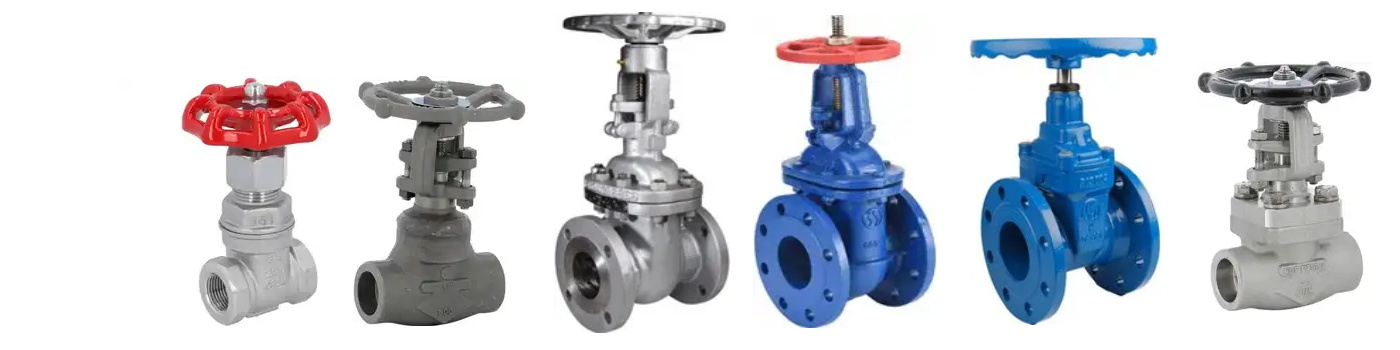
What types of gate valves are available?
Gate valves are available in several configurations. The choice depends on the medium, pressure class, and available installation space.
- Wedge gate valve – the most commonly used type. The wedge-shaped gate self-wedges into the seat on closing. Suitable for high pressures and high temperatures in water, steam and gas applications.
- Parallel gate valve – the gate moves parallel to the seat without self-wedging. Better suited to temperature fluctuations; therefore commonly used in steam installations subject to thermal expansion.
- Knife gate valve – fitted with a sharp blade that cuts through the medium. Suitable for media containing solid particles, slurries or pulp. Also used in wastewater installations.
- Rising stem – the stem moves upward when opening. This provides a clear visual indication of whether the valve is open or closed. Common in larger diameters and installations with sufficient headroom.
- Non-rising stem – the stem remains in place; internal threading moves the gate. More compact and suitable for confined pit or cabinet installations.
Comparison: gate valve versus other valves
Not every valve is the right choice for every situation. The table below compares the gate valve with four commonly used alternatives across the most practically relevant criteria.
| Criterion |
Gate valve |
Ball valve |
Butterfly valve |
Pinch valve (plate) |
Pinch valve (hose) |
| Pressure drop when open |
+ Minimal |
+ Minimal |
- Moderate |
- Moderate |
- Moderate |
| Switching speed |
- Slow (handwheel) |
+ Fast (quarter-turn) |
+ Fast (quarter-turn) |
+ Fast (quarter-turn) |
+ Fast |
| Large diameters (DN>150) |
+ Well available |
- Heavy and costly |
+ Suitable |
+ Suitable |
- Limited |
| Sealing quality |
+ High |
+ High |
- Lower at high pressure |
- Limited |
+ Good (no internal parts) |
| High temperatures |
+ Up to 400°C+ |
+ Good (metal) |
- Limited by elastomer |
- Limited |
- Limited (sleeve) |
| Media with solid particles |
+ Knife type possible |
- Not suitable |
- Not suitable |
+ Suitable |
+ Very suitable |
| Abrasive / aggressive media |
- Limited |
- Limited |
- Limited |
- Limited |
+ Excellent |
| Installation space |
- More headroom required |
+ Compact |
+ Compact |
+ Compact |
+ Compact |
| Price per DN at large sizes |
- Higher |
- High |
+ Lower |
+ Lower |
+ Lower |
| Suitable for flow control |
- No |
- No |
+ Limited |
- No |
+ Limited |
Choose a gate valve when dealing with large diameters, high pressures or high temperatures where minimal pressure drop and reliable shut-off are required. For fast switching in smaller diameters, a ball valve is generally more practical and compact. Working with abrasive media, slurries or powders? A pinch valve is the better choice: the medium only contacts the flexible sleeve, completely preventing wear of the valve body.
Where is a gate valve used?
Gate valves are used in sectors where high pressure, high temperature or large diameters are a factor. Typical application areas include:
- Water treatment and drinking water – DN50 to DN600, connection to pumps, filters and reservoirs. Certifications such as WRAS or KIWA are available on request.
- Steam and combined heat and power installations – parallel gate valve for applications with high temperature fluctuations and thermal expansion.
- Oil and gas installations – high-pressure versions in carbon steel (WCB) or low-alloy steel, PN40 and above.
- Chemical industry – corrosion-resistant versions in stainless steel (CF8M/SS316) or duplex steel for aggressive media.
- Paper and pulp industry – knife gate valve for slurries and media containing solid particles.
- Marine and offshore – compact non-rising stem in confined installation spaces, often used alongside check valves in the same piping system.
- Media with solid particles and abrasive substances – consider a pinch valve in these cases. Pinch valves have no internal moving parts that contact the medium, making them ideal for granulates, slurries, powders and fibres where a gate valve — even in knife configuration — will wear more quickly.
What to consider when selecting a gate valve?
A gate valve is selected based on the following technical parameters. Not all data available? Our technical team is happy to assist.
- Nominal pressure (PN) – common pressure classes: PN10, PN16, PN25, PN40. For high-pressure installations, classes up to PN100 and above are available.
- Nominal diameter (DN) – from DN15 to DN600. For larger diameters, custom solutions apply; request a quote.
- Medium – water, steam, gas, crude oil, chemicals or media with solid particles determine the material selection.
- Process temperature – determines the packing material (PTFE, graphite, metal) and valve body material.
- Body material – cast iron (EN-GJL-250), ductile iron (EN-GJS-400/500), carbon steel (WCB), stainless steel (CF8M), duplex or plastic (PVC, PP, PVDF).
- Actuation – handwheel, extension spindle, electric actuator or pneumatic actuator. Electrically and pneumatically actuated versions are available for automated installations.
- Standards and certifications – EN 1171 (cast iron gate valves), EN 12266 (pressure testing), ATEX for hazardous environments.
Note: applications in drinking water or food processing may require specific certifications (such as WRAS or DVGW). Ask about available certificates when in doubt. For installations that also require check valves alongside shut-off valves, we supply both components.
How to buy a gate valve from Ebora
Ebora supplies gate valves from small diameters to large industrial sizes, in versions for water, steam, gas and chemical media. You will find the complete range in the product overview on this page. Use the filters for PN class, DN and material to quickly identify the right configuration.
Not sure which gate valve you need? Select based on the technical parameters or contact our technical sales team. We advise you on the right choice based on pressure, medium, diameter and installation environment — and prepare a full quotation where required.
Frequently asked questions
When should I choose a gate valve instead of a ball valve?
A gate valve is the better choice for large diameters (DN150 and above), high temperatures, or where minimal pressure drop during flow is required. A ball valve switches faster and is more compact, but is less suited to the combination of large diameter and high pressure class.
How do I recognise a gate valve from the outside?
A gate valve is recognisable by the tall, rectangular or tapered bonnet on top of the valve body. With a rising stem, you will see the stem rise as the valve opens — a clear visual indication of its position. Actuation is via a handwheel or actuator on top of the bonnet, never sideways as with a ball valve or butterfly valve.
Can a gate valve be used for flow control?
No. A gate valve is intended exclusively for fully open or fully closed operation. In a partially open position, the medium accelerates along the gate edges, causing erosion and significantly shortening service life. For flow control, use a control valve or butterfly valve. For abrasive media or slurries where some degree of control is needed, a pinch valve offers more flexibility.