


Contact with Ebora
Ebora BV
Poort van Midden Gelderland Rood 8
NL-6666LT
Heteren
The Netherlands
+31(0)26 370 6830
info@ebora.nl
Opening hours: Monday to Friday from 8:30 AM to 5:00 PM


 |
|
The name Ebora has existed for over a century. It began in a workshop in Kingston-on-Thames, where a Dutch engineer sawed propellers from mahogany during the First World War. It ended — for now — in a company in Heteren supplying valves, pneumatics and instrumentation to industry. In between lies a life full of inventiveness, adversity, war and craftsmanship. This is the story of Jan Schiere, the man behind the name. Efficiency By Our Rotative Aerofoils |
 |
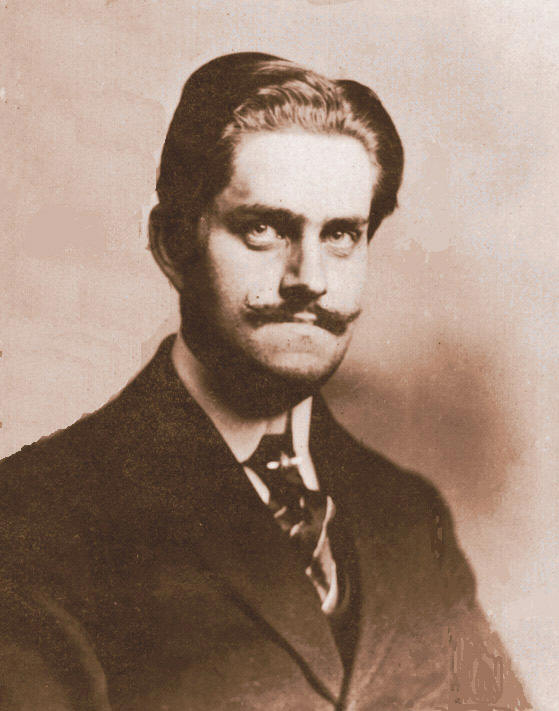 |
On 19 December 1888, Jan Schiere is born in Zaandam, the son of a paint manufacturer. The family belongs to the town's notables. His mother has an exceptional talent for drawing — a gift Jan partly inherits. At school he begins drawing aircraft: models, side elevations, propeller designs on paper. Jan is taken to school every day by horse-drawn carriage — the transport of a prosperous family. The flights of the Wright brothers make a deep impression on him. He keeps prints of Orville Wright taking the Prussian Crown Prince up in October 1909. These are the first signs of what will become a lifelong fascination with aviation. When Jan is six years old, his father dies at the age of 46. In 1906 Jan obtains his secondary school diploma and moves with his mother to The Hague. |
Jan wants to become an aeronautical engineer. At the time, the Technical University of Delft does not offer this programme. He presumably works or does an internship at a technical company in Delft — among his estate are drawings of safety valves and valve housings, the kind of work that fits a placement at a company like the then Econosto. It is a remarkable detail: precisely the product categories his grandson would sell a century later.
In 1909 Jan leaves for Paris to follow the programme at the École Supérieure d'Aéronautique et de Construction Mécanique. His mother gives him one condition: he must never fly himself. She has already lost two children and a husband — she will not take that risk again.
In July 1911 Jan passes his exams. He sends his mother a telegram from Paris: GESLAAGD JAN. INGENIEUR AERONAUTE. He is the first qualified aeronautical engineer in the Netherlands. His graduation thesis — Projet d'Aeroplane d'élève Jan Schiere — is now part of the collection of the Aviodrome in Lelystad.
 |
 |
Telegram to his mother: GESLAAGD JAN. INGENIEUR AERONAUTE |
Business card of Jan Schiere sr. as Ingénieur-Aéronaute, École Supérieure d'Aéronautique |
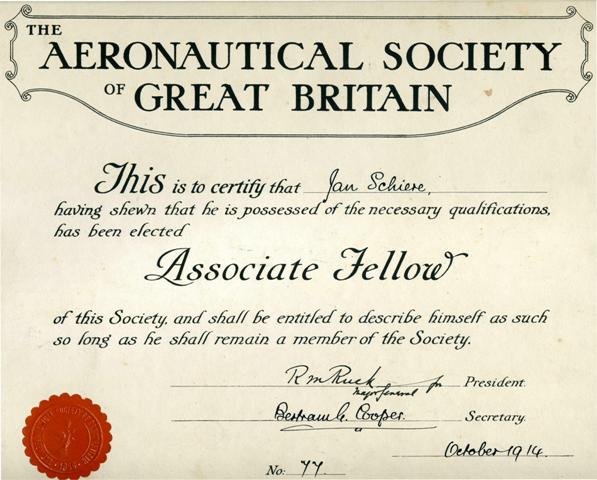 |
Certificate as Associate Fellow of the Aeronautical Society of Great Britain (member no. 77, October 1914)
Back in the Netherlands, Jan immediately encounters a matter of principle. The Ministry of the Colonies wants to purchase aircraft from Belgian manufacturer De Brouckère for the Dutch East Indies. Jan considers the aircraft dangerously unsafe and says so publicly — through letters to newspapers and as a regular contributor to the journal De Luchtvaart. He is also a member of the Technical Committee of the Royal Dutch Aviation Association, which gives his criticism added weight. De Brouckère sues him and demands compensation. The court dismisses the claim but declines to rule on the aircraft's safety.
The Aviodrome holds the complete series of articles and rebuttals from the specialist press of those years — two bound volumes totalling some 160 pages.
 |
|
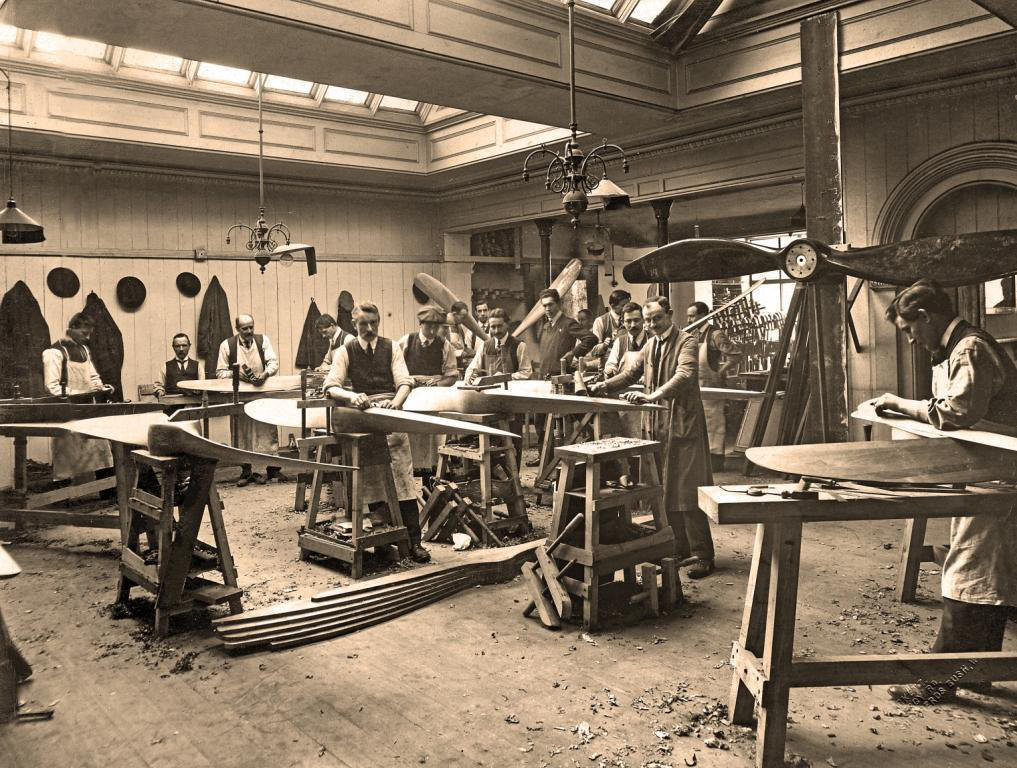
In 1914 Jan leaves for England, his mother accompanying him. He works briefly at Handley Page, which at that time manufactures its own propellers. He then takes the step towards independence. On 1 April 1915 he opens his own propeller factory in Kingston-on-Thames at 11-12 Surbiton Park Terrace. He lives in a house called Woodsides in Woodbines Avenue, within walking distance of the factory. The company becomes a contractor to the Admiralty and the War Office. On 16 December 1916 it becomes an official Limited Company with a nominal capital of £4,000. Besides Jan there are two other directors: Stuart Cole, a London chartered accountant, and Franc Bergery Derocle, an engineer from Exeter. |
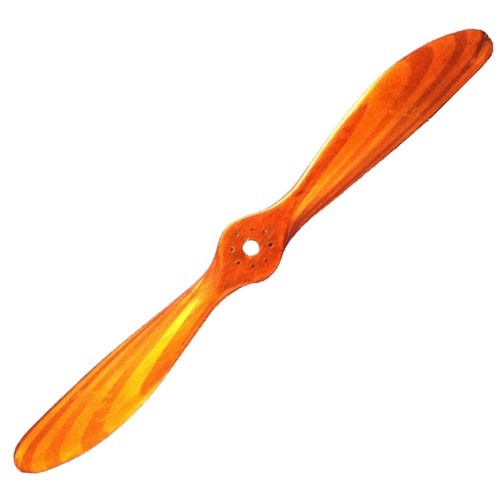
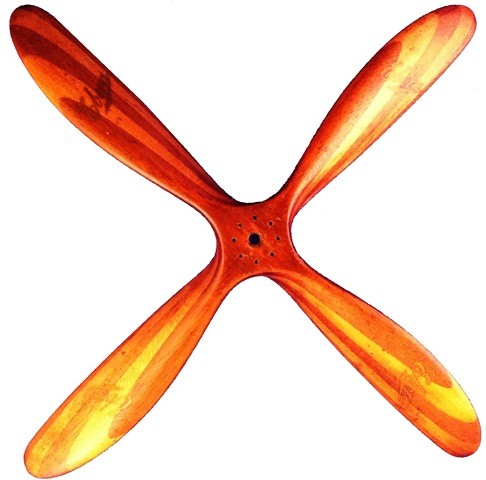
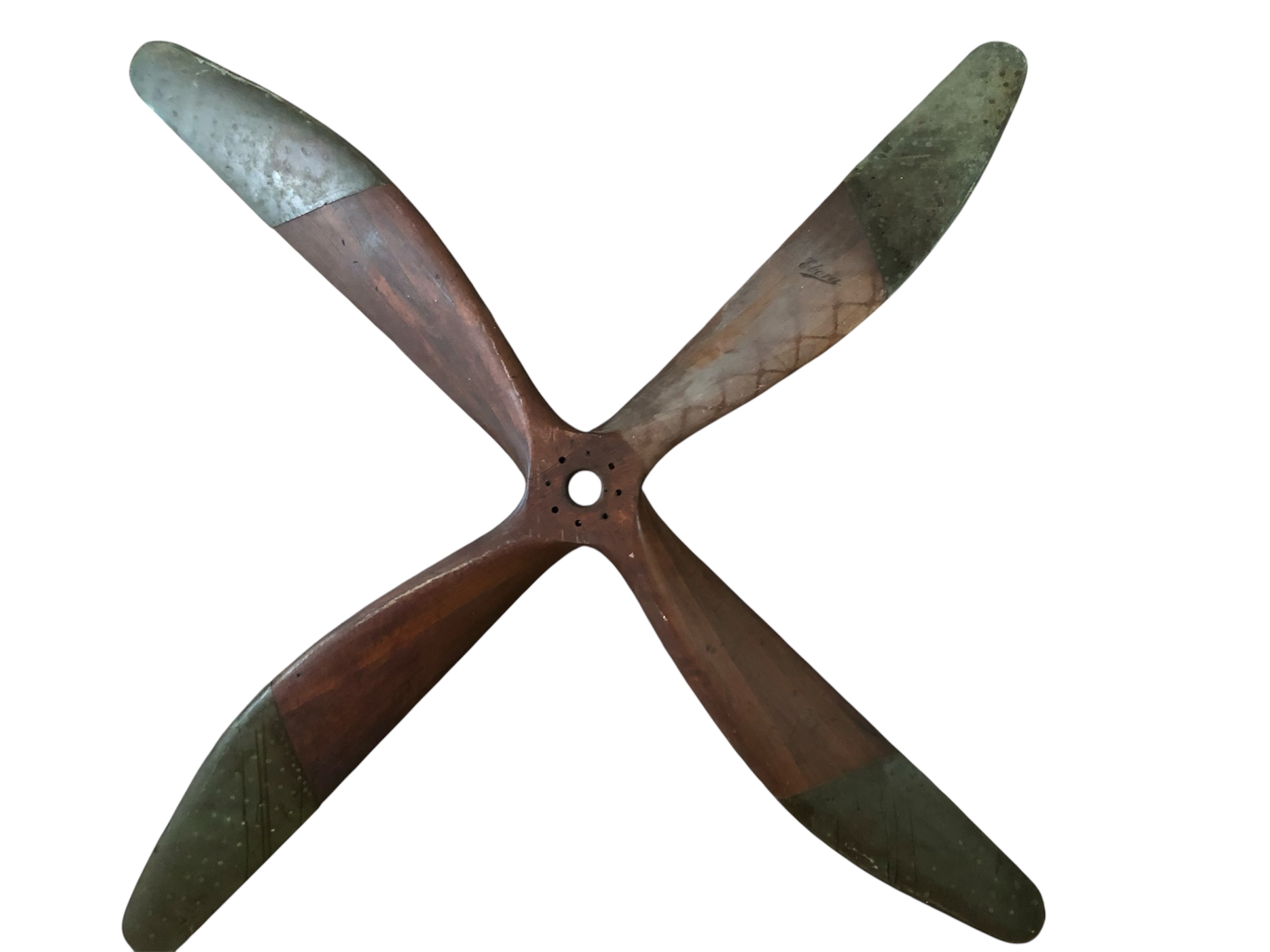
The propellers are made from mahogany. Jan builds approximately 200 different designs — for the Royal Naval Air Service, the Royal Flying Corps and the Royal Aircraft Factory. Eighty of those designs are made under government contract. Among his customers are aircraft types such as the BE2, the Sopwith Pup, the Sopwith Camel, the DH4, the DH9, the Bristol F2B and the SPAD. The British SPAD S7 flies exclusively on propellers of Jan's own Ebora design.
|
 |
 |
 |
Typical Ebora propellers — Anzani version and type 26, front and side view
Two- and four-blade auxiliary propellers |
Each propeller receives an Ebora type number and is fitted with a distinctive decal — first green and embossed, later a gold water transfer. In addition to full-size aircraft propellers, Ebora also manufactures smaller auxiliary propellers for generators and oil pump drives, slate propeller test stands, wing ribs, spars and other aircraft components. |
 |
||
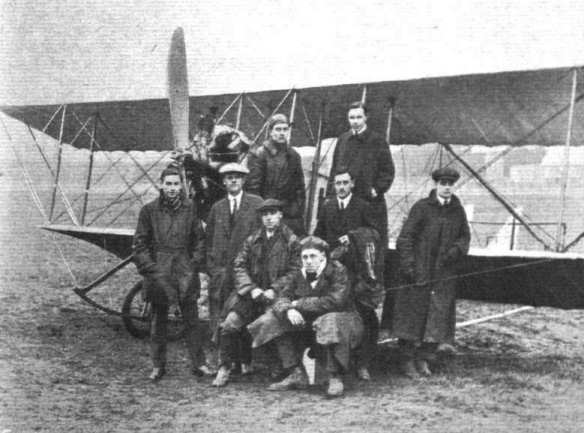
Publication in Flight Magazine, 15 June 1916 — a Caudron with Ebora propeller at the Hall Flying School in Hendon |
Jan is outspoken about the aviation community of those years. In a letter from January 1919 to aviation journalist Henri Hegener, he writes about Anthony Fokker: "Dat Fokker verloofd is vind ik heel interessant, ik zou zoo denken dat er al genoeg onechte kinderen van hem rondloopen, dat hij al genoeg gefokt heeft." It typifies the tone in the small world of the early aviation pioneers — direct men with strong opinions about one another.
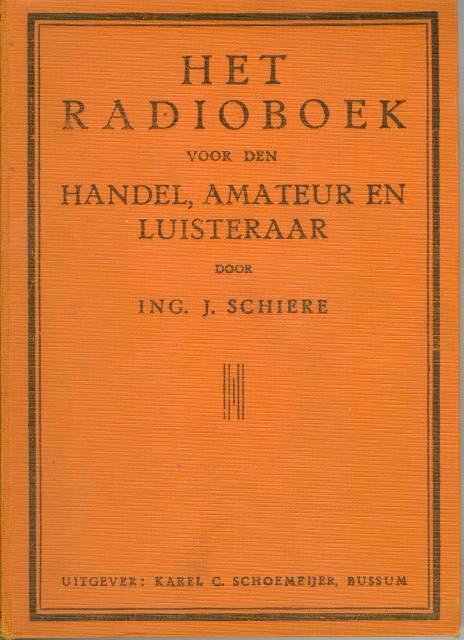 |
With the sudden armistice in November 1918, orders are cancelled en masse. Stocks of mahogany — scarce and expensive during the war — collapse in value. At the same time the British government imposes an excess profits tax over the war years. Jan tries to use the remaining wood to make clock cases, but that too comes to nothing. On 15 August 1923 creditor George Coplestone Carter appoints a receiver. The remaining assets are auctioned for £786-17s-6d. In the early 1920s Jan returns to the Netherlands. He opens a shop in radio components at Stadhouderslaan 5 in Utrecht. Under the Ebora brand he builds and sells valve radios. He also writes a book — Radioboek voor den amateur en luisteraar — of which more than fifty thousand copies are sold. |
 |
Radio book |
Preliminary edition |
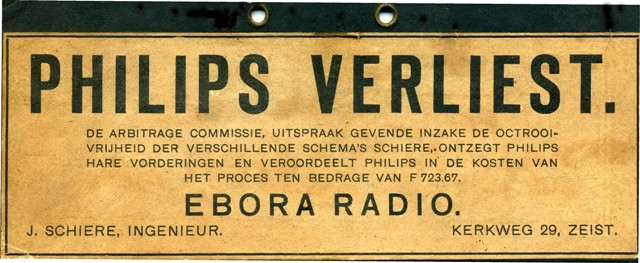
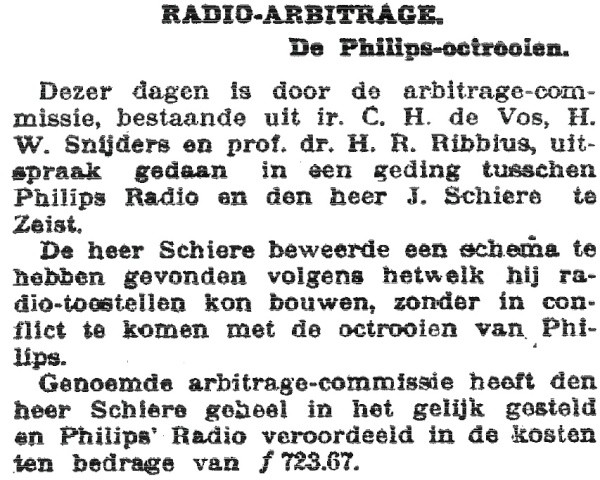
In 1927 Jan settles in Zeist, at Kerkweg 29. His radio business grows steadily. Jan sells so-called patent-free receivers — radio sets he deliberately designs to fall outside Philips' patents. Philips disagrees and accuses him of patent infringement. Jan contests the case. The arbitration committee rules entirely in Jan's favour. Philips loses.
 |
 |
PHILIPS LOSES — advertisement by Ebora Radio |
The arbitration ruling: Philips loses to Ebora |
It is a remarkable victory for a small independent trader against one of the most powerful industries in the Netherlands. Jan also leaves behind his own measuring instrument: the Ebora emission meter, his own design from the radio era.
 |
||
An Ebora emission meter — his own design from the radio era |
His heart remains with aviation. In 1936 he designs two glider types: the Zögling and the Koekoek. Three aircraft are built in his factory at 1e Hogeweg in Zeist. The first Zögling flies in late 1936 and is used by the Stichtsch Gooische Vereeniging voor de Kleine Luchtvaart, which Jan co-founds. The Koekoek — an improved version with a more enclosed cockpit — is used by the Hague Gliding Club, which names it Windekind.
Photographs show Jan at the controls of the Zögling. He does not fly. He keeps his promise to his mother.
As well as being an engineer and entrepreneur, Jan Schiere is one of the first Dutch aviation collectors. He builds an archive ahead of its time: aircraft and propeller drawings, circuit diagrams of his Ebora valve radios, technical drawings of safety valves and valve housings, logbooks of the Graf Zeppelin, a guestbook from the historic Pelikaan flight from the Netherlands to Batavia, and flight data and instruments.
One of the most remarkable objects in his collection is a badly damaged wallet. After restoration by the Aviodrome it turns out to be the wallet of Heinrich van der Burg — Dutch pioneer aviator, known for his demonstration flights in a Bleriot. On 1–4 August 1912 Van der Burg flew at Overslag in Belgium, for which the organising committee presented him with this wallet, presumably with contents. Printed in gold lettering is the date: 4 OOGST 1912. How Jan came to own it remains a mystery — but it fits a man who followed early aviation closely and documented what others let disappear.
When the Second World War breaks out, Jan and his family live at Roemer Vischerlaan in Zeist. Their neighbours are the Jewish Unger family. When the situation for Jewish families becomes dangerous, Jan and his wife Maria help at least six people into hiding. Jan uses his knowledge of radio technology to support the resistance. At the same time, German officers are billeted in the front room while those in hiding are kept at the back of the house. Maria's fluency in German helps. She worked for a time as a young woman in Düsseldorf, at the Krupp factories.
After the war, the fur coat the Unger family had left in their keeping can be returned. Mrs Unger survived the war.
On 15 September 1943 Jan Schiere dies of a heart attack, aged 54. He leaves his wife and children virtually destitute.
|
Decades later his grandson Frank Schiere needs a company name. It is Frank's father — Jan's son — who suggests the name Ebora. Frank has never heard of it. But the name comes early in the alphabet, has only one possible spelling, the website is still available and the logo is free. Frank chooses the name. Only later, when clearing out his father's house after his death, does Frank understand what he has chosen. Among the belongings he finds aircraft and propeller drawings, Ebora valve radio circuit diagrams, Graf Zeppelin logbooks, a guestbook from the Pelikaan flight to Batavia and the wallet of Heinrich van der Burg. And among it all: drawings of safety valves and valve housings — precisely the products Frank was already selling under that same name. Frank donated most of the aviation items to the Aviodrome in Lelystad, where they form part of the Jan Schiere archive. The technical drawings he keeps himself. |
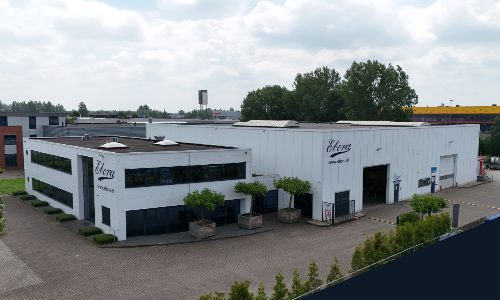 |
In 2000 Frank Schiere founded Ebora in Heteren as a technical distributor of pneumatics, instrumentation and valves. From propeller factory to radio manufacturer to industrial supplier — Ebora always designed, built and improved from a basis of technical knowledge. The name connects over a century of craftsmanship, from mahogany propellers in Kingston to safety valves and valves in Dutch industry.