Globe valve – ARI-Armaturen, Spirax Sarco and Festo | Ebora
How do you recognise a globe valve?
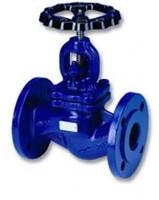
A globe valve is recognisable by its rounded, globe-shaped body: the medium does not flow straight through, but follows a curved path across the seat. This makes the body noticeably rounder and heavier than a ball valve or gate valve. The spindle protrudes from the bonnet at the top and moves vertically down to the disc. In a rising stem design, the spindle rises visibly when the valve opens — providing a direct position indication without additional accessories. The bonnet above the body, which houses the packing and spindle seal, is another distinguishing feature that sets the globe valve apart from butterfly or ball valves.
How does a globe valve work?
The disc moves perpendicular to the seat via the spindle. As the valve opens, the annular flow passage gradually increases, raising the Kv value and proportionally increasing the flow rate. Depending on the trim, the valve has a linear or equal-percentage control characteristic — making it well suited for modulating control. Bear in mind that pressure drop is higher than with ball or gate valves; in return, you gain precise flow control. Packing and seals in the bonnet prevent leakage along the spindle.
Types of globe valves
Ebora supplies globe valves in three actuation variants:
- Manually operated – direct handwheel operation, suitable for installations that are rarely actuated
- Pneumatically actuated – driven by compressed air, ideal for centralised automation or frequent switching; spring return provides a fail-safe position on air failure
- Electrically actuated – motor-driven, suitable where no compressed air is available
Globe valve or bellows valve – what is the difference?
A bellows valve has no conventional spindle packing: the spindle is hermetically sealed with a metal bellows, making it leak-free to atmosphere. This is required for toxic, radioactive or highly corrosive media where even minimal external leakage is unacceptable. A globe valve uses packing around the spindle, which wears over time and requires periodic maintenance.
| Property |
Globe valve |
Bellows valve |
| Spindle sealing |
Packing (PTFE, graphite) |
Metal bellows, leak-free |
| Maintenance |
Periodic packing replacement |
Inspect bellows for fatigue |
| Application |
Steam, water, general process |
Toxic, radioactive or aggressive media |
| Cost |
Lower |
Higher |
Choose a globe valve for standard process media. Choose a bellows valve when external leakage is absolutely unacceptable.
Materials and sealing
The choice of material and packing determines service life in your installation:
- Brass / bronze – suitable for water, steam and compressed air up to approx. 200°C
- Cast iron – for larger diameters and lower pressures in water and gas lines
- Carbon steel (WCB) – for higher pressures and temperatures in process industry
- Stainless steel (316) – for corrosive media, food processing and pharmaceutical applications
Packing materials: PTFE (chemical resistance, low friction), graphite (high temperature, steam) and bellows (leak-free). Always match packing choice to medium, temperature and pressure class.
Brands and product range
For steam applications, Ebora supplies globe valves from Spirax Sarco — a specialist brand for steam and condensate systems with a broad range in steel and stainless steel. For industrial process applications, ARI-Armaturen represents the largest range in our portfolio with over 380 variants, available in cast iron, steel and stainless steel across a wide range of pressure and temperature classes. Festo supplies pneumatically actuated versions suitable for automated installations. We also carry globe valves from FIP, Goetze Armaturen and Norgren for specific applications.
Applications by sector
- Steam and condensate systems – gradual opening prevents water hammer; Spirax Sarco versions designed specifically for steam applications
- Chemical process industry – precise flow control with aggressive media; ARI-Armaturen in stainless steel or coated versions
- Heat exchangers and HVAC – proportional control of heat-carrying media
- Pharmaceutical industry – hygienic stainless steel versions with PTFE packing
- Marine and offshore – heavy-duty versions in bronze or duplex stainless steel for saline environments
Selection guide – which type suits your application?
| Situation |
Recommended type |
| Steam or condensate |
Spirax Sarco globe valve in steel or stainless steel |
| Industrial process, broad range |
ARI-Armaturen, cast iron to stainless steel |
| Pneumatic automation |
Festo globe valve with compressed air actuation |
| Toxic or radioactive medium |
Bellows valve (no packing) |
| Corrosive medium, food industry |
Stainless steel globe valve with PTFE packing |
| Plastic piping system |
FIP globe valve |
| ATEX zone, pneumatic actuation |
Pneumatic globe valve with spring return |
Select your globe valve based on DN, pressure class (PN), medium and actuation — or request a technical quote directly via our contact page.
Frequently asked questions
When should I choose a pneumatic globe valve?
A pneumatic globe valve is the right choice when you want to control multiple valves centrally, switch frequently, or require fast response. Spring return provides a fail-safe position on air failure — fail-open or fail-close — which improves process safety. Combined with a positioner, precise modulating control is possible even under varying process conditions. Pneumatic actuation performs well in ATEX zones where electric drives are less desirable.
What is the Kv value of a globe valve and why does it matter?
The Kv value indicates how many cubic metres of water per hour flow through the globe valve at a pressure differential of 1 bar. When selecting a valve for control applications, you calculate the required Kv based on the desired flow rate, medium and available pressure differential. A Kv that is too low restricts flow; one that is too high makes accurate control difficult.
How do I maintain a globe valve?
Inspect the spindle packing, seat and disc regularly for wear or erosion. Replace the packing promptly to prevent leakage along the spindle. Lubricate and clean the spindle thread according to the manufacturer's instructions. For pneumatic versions, also check air quality (filter/regulator/lubricator) and the function of limit switches and positioner. Always perform a pressure and leak test after maintenance before returning the valve to service.
Can a globe valve be used for gas?
Yes, globe valves are suitable for gas — provided the version is certified for the gas type and pressure class involved. Pay attention to packing selection: PTFE is standard for compressed air and inert gases. Always verify that the globe valve carries the appropriate PED certification (Pressure Equipment Directive 2014/68/EU) for your application. For flammable or toxic gases, a leak-free bellows version may be required.
Select the right globe valve based on DN, pressure, medium and actuation — or let our specialists advise you. Contact us for a technical consultation or direct quote.


