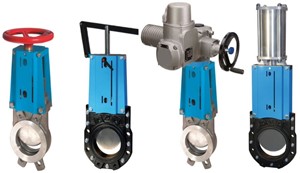
What is the difference between a knife gate valve and a gate valve?
A gate valve operates on a similar principle — a gate moves perpendicular to the flow direction — but is primarily intended for clean or lightly contaminated media and higher pressure classes. The knife gate valve is distinguished by the cutting action of its blade: the medium is displaced or partially cut during the closing stroke. This makes the knife gate valve suitable for media containing solid particles, fibres, or high viscosity, where a gate valve would clog or wear rapidly. The knife gate valve also has a shorter face-to-face dimension.
| Property |
Knife Gate Valve |
Gate Valve |
| Media suitability |
Slurry, fibres, powders, wastewater |
Clean fluids, steam, gas |
| Cutting action |
+ |
- |
| Face-to-face length |
Short (EN 558-1 series 20) |
Longer |
| Pressure drop (open) |
Low |
Low |
| Standard pressure class |
PN10 |
PN10–PN40 |
| Suitable for steam |
- |
+ |
For which media is a knife gate valve suitable?
The knife gate valve is designed for media where other valve types fall short. Typical applications include:
- Wastewater, sewage and contaminated water
- Slurry, sludge, dredging slurry and manure
- Fibrous liquids and viscous media
- Bulk solids such as powders, granulates, sand, gravel and cement
- Paper pulp and biomass
- Food processing residuals such as potato peels, egg shells and slaughterhouse waste
Please note: knife gate valves are not suitable for steam applications. For steam systems, please refer to other valve types.
Which design should you choose?
Select the design based on your system and medium:
| Design |
Apply when |
| Single-sided sealing |
Wastewater, powders, manure, slaughterhouse waste — pressure from one direction |
| Double-sided sealing |
Closed systems where pressure can occur from both sides; wastewater, contaminated water |
| With deflector |
Abrasive media such as cement, sand, gravel, gypsum and granulates — guides flow to the centre to minimise wear |
| Through-conduit plate |
Pulp and paper industry and applications where dead space in the open position must be minimised |
The body is supplied as standard in grey cast iron GG-25 with polyester coating (190°C, 20 min baked). Alternatively, Ebora supplies the knife gate valve fully in stainless steel 1.4408, including the superstructure.
Which actuation do you choose?
Knife gate valves are available with various actuation options:
- Handwheel (non-rising stem) — for manual operation at accessible locations
- Lever or chain wheel — for manual operation at height or from a distance
- Pneumatic actuator (double-acting or single-acting with spring return) — for automated applications; fail-safe closing or opening available
- Electric actuator — for applications without compressed air
For safety applications, pneumatically operated knife gate valves are available with an external pressure vessel. This ensures a controlled movement to the safety position when the compressed air supply fails. The safety valves in your system combine well with these fail-safe designs. All automated knife gate valves are supplied in accordance with Machinery Directive 2006/42/EC with protective covers.
Sealing materials — which do you choose?
The seat seal determines media compatibility and temperature resistance. Choose based on your application:
| Seal |
Temperature |
Application |
| NBR |
-25°C to +90°C |
Fats, oils, liquids |
| EPDM |
-35°C to +120°C |
Aqueous media, abrasive substances |
| FKM (FPM) |
High temperatures |
Corrosive media — on request |
| Silicone |
Up to +200°C |
Food industry, pharmaceuticals |
| PTFE |
pH 2–12 |
Corrosive media; leakage ±0.5% Kv |
| Metal |
Variable |
Minor leakage acceptable; higher temperatures |
The gland packing is supplied as standard as a three-part set with synthetic fibre (PTFE-coated), a reinforced Kevlar® packing and an NBR, EPDM or FKM ring.
Where are knife gate valves used?
Knife gate valves are the preferred choice in industries where media is not clean and conventional valves such as butterfly valves or diaphragm valves are insufficiently resistant to wear or clogging:
- Wastewater and sewage treatment
- Pulp and paper industry
- Biogas production
- Mining and dredging applications
- Silo discharge and bulk transport
- Slaughterhouses and food processing industry
- Drainage and soil remediation systems
Tip: Operate your knife gate valve fully open and fully closed every few months, even when it normally remains in the same position. This prevents mineral build-up and significantly extends service life.
Special options and configurations
Ebora supplies knife gate valves with various options for specific applications:
- V-port for control applications and accurate dosing, combined with a positioner
- Limit switches (mechanical or inductive) for open and closed position feedback
- Flushing connection for keeping the valve seat clean
- Stem extension, mechanical stops and locking devices
- Manual override for automated versions
- Solenoid valve and electropneumatic positioner
Flanges are dimensioned as standard to PN10 EN1092-1. On request, versions are available for PN16, ANSI 150 or special flanges, and for nominal diameters larger than DN400.
Select your knife gate valve based on medium, diameter, pressure class and actuation type, or request a quote directly via our contact form.
Frequently asked questions
What is the difference between single-sided and double-sided sealing?
A single-sided knife gate valve seals from one direction and is used in applications where the pressure direction is fixed, such as wastewater installations and silo discharge. A double-sided knife gate valve is independent of pressure direction and suitable for closed systems where pressure can occur from either side.
How do I recognise a knife gate valve that needs maintenance?
The most common cause of malfunction is mineral build-up on the seat or blade. Indicators include higher operating torque than normal, leakage in the closed position or incomplete closure. Ebora supplies spare parts and can advise on repair or replacement.
Can a knife gate valve be used for flow control applications?
Yes. With a V-shaped port in the blade, flow can be controlled more precisely. Combined with a pneumatic or electric actuator and a calibrated positioner, the knife gate valve is also suitable for dosing and control applications.
What is the maximum temperature for a knife gate valve?
This depends on the sealing material. NBR is suitable up to 90°C, EPDM up to 120°C and silicone up to 200°C. For higher temperatures or corrosive media, Ebora recommends FKM or a metal seat. Please contact us for application advice in borderline cases.


