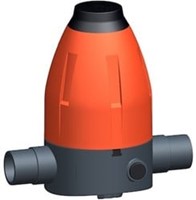
How does a pressure relief valve work?
The opening characteristic of a pressure relief valve follows six stages:

- Set pressure is reached; the valve remains closed.
- Set pressure is exceeded; the valve opens proportionally to the overpressure.
- At the required overflow rate, the valve self-adjusts to maintain the set pressure.
- As system pressure decreases, the valve begins to close.
- Pressure continues to drop; the valve closes further.
- Just below the set pressure, the valve is fully closed.
This proportional behaviour distinguishes the back pressure valve from a safety valve, which opens abruptly and fully at a defined set point.
Back pressure valve or pressure reducing valve — what is the difference?
Both valve types control pressure, but in opposite directions within the system. A back pressure valve maintains constant pressure upstream (before the valve). A pressure reducing valve maintains constant pressure downstream (after the valve). Selecting the wrong type will result in an unstable installation. Determine first whether you need to control pressure on the supply side or the consumer side. If in doubt, contact our specialists via the contact page.
Pressure relief valve vs. safety valve — what is the difference?
This is the most common selection error in the field. A pressure relief valve (back pressure valve) is a control component: it opens proportionally and may relieve pressure continuously. A safety valve is a protective device that opens abruptly at a defined pressure to protect equipment from dangerous overpressure. Safety valves fall under the Pressure Equipment Directive (PED) and cannot be replaced by a pressure relief valve. Use each component for its intended function only.
When should you use a back pressure valve?
Back pressure valves are used across a wide range of industrial applications:
- Pump bypass and minimum flow: prevents overheating, cavitation or mechanical damage when a pump operates against a closed valve.
- Process lines in food and general industry: maintains stable supply pressure for valves, pneumatic components or dosing points.
- Filtration and CIP loops: maintains a constant upstream pressure when resistance in the line varies.
- Distribution loops and mixing circuits: buffers pressure peaks from rapidly changing consumers.
This valve type is frequently used in combination with a pressure sensor or pressure gauge for accurate monitoring and set point adjustment.
Versions and materials
Back pressure valves are available in multiple material versions depending on the medium and process requirements:
| Material |
Application |
| Stainless steel (SS) |
Hygienic and corrosive media, food and chemical industry |
| PVC-U |
Chemically resistant applications, lightweight construction |
| PP |
Aggressive media, temperature resistant up to approx. 60 °C |
| PVDF |
High-grade chemical resistance, cleanroom applications |
Connections are available with female thread, male thread, solvent cement socket or flange (DIN/ANSI depending on model). Spring ranges cover low to high pressure; always verify the spring range, maximum process temperature and media compatibility before selection.
How to select the right back pressure valve
Use the selection guide below for a quick pre-selection:
| Parameter |
What to consider |
| Set pressure |
Required minimum upstream pressure under operating conditions |
| Overflow capacity |
Required bypass flow at maximum pump or process demand (use Kv/Kvs) |
| Medium |
Chemical compatibility with seals and body material |
| Temperature |
Check maximum process temperature per material version |
| Installation |
Follow flow direction; prevent dirt or fibres entering without an upstream strainer |
| Function |
Direct-acting for simple applications; pilot-operated for high flows or rapid pressure fluctuations |
Not sure about the Kv value or the correct setting? Our specialists are happy to calculate the right size with you — request a quote or technical advice via our contact page.
Installation and adjustment
Correct installation largely determines whether the valve performs as intended:
- Positioning: install in the bypass or return line; maintain straight inlet and outlet runs where specified by the manufacturer.
- Measuring: fit a pressure gauge or pressure sensor upstream (before the valve) to read and adjust the set pressure correctly.
- Setting: adjust the set screw under actual operating conditions and lock the setting after adjustment.
- Verification: vary the flow demand and confirm that the upstream pressure remains stable within the required range.
- Maintenance: if the valve continues to "leak", first check for contamination or a damaged seat/seal; also verify that the flow direction is correct.
Back pressure valves are frequently combined with ball valves as isolation valves for maintenance or bypass isolation.
Frequently asked questions
Can a back pressure valve be used as overpressure protection?
No. A back pressure valve is a control component, not a safety device. It opens proportionally and is not certified as a protective device under the PED directive. For overpressure protection you require a safety valve that complies with applicable standards and regulations.
What is the difference between a direct-acting and a pilot-operated back pressure valve?
A direct-acting back pressure valve responds directly to upstream pressure via a spring. This type is suitable for smaller flows and straightforward applications. A pilot-operated version uses a separate pilot signal for control, offering more precise pressure regulation at higher flow rates or during rapid pressure fluctuations.
Why does my pressure relief valve keep leaking?
Continuous leakage typically indicates a contaminated seat, damaged seal or a set pressure that is too low relative to the system pressure. First check the flow direction and clean the seat. Replace the seal if wear is visible. If the set pressure is correct but the valve continues to leak, consult a specialist.
Which pipe materials are compatible with a back pressure valve?
Back pressure valves are available in stainless steel, PVC-U, PP and PVDF, making them suitable for use in stainless steel, plastic and composite piping systems. The choice depends on the medium, pressure and temperature. Always match materials or use appropriate transition fittings.
Select the right back pressure valve based on set pressure, media compatibility and required bypass capacity, or contact our specialists for a no-obligation technical consultation.


