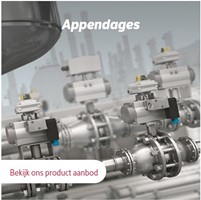
Which types of appendages are available?
Shut-off valves and control valves
- Ball valves – quarter-turn operation, high tightness, suitable for a wide range of media
- Butterfly valves – cost-effective at large diameters, low pressure drop, short face-to-face length
- Gate valves – full bore, low pressure drop, widely used in water and utility networks
- Diaphragm valves – hygienic design, minimal dead space, suitable for clean steam and food applications
- Control valves – linear or equal-percentage trim for precise process control
- Needle valves – fine regulation of small flow rates, high pressure resistance
Safety equipment
- Safety valves – open at set pressure, CE/PED-compliant
- Check valves – prevent backflow and water hammer, available with soft-close damping
Measurement and control equipment
- Flow meters – volumetric or mass flow, including totalisation and leak detection
- Pressure gauges & transmitters – local readout and 4–20 mA signal for monitoring and control
Filters and strainers
Y-strainers and basket strainers protect valves and measuring equipment from contamination and extend the service life of your installation.
Where are appendages used?
Each sector has specific requirements for material, certification and cleanability.
Process industry – chemical, pharma, food & beverage
Sanitary diaphragm valves and cavity-filled ball valves in 316L/EP finish minimise dead spaces and meet EHEDG requirements. IO-Link and digital protocols make maintenance predictable and ensure traceability.
Buildings and utilities – water, HVAC
Gate valves and butterfly valves handle distribution; pressure-reducing and relief valves maintain comfort and safety. Flow meters support consumption monitoring and energy savings.
Steam and energy
Vortex and ultrasonic flow measurement, steam traps and safety valves are essential for efficiency and safety. Water hammer control via dampers and soft-close check valves prevents damage to pipework.
Maritime and offshore
Corrosion-resistant materials in duplex stainless steel or bronze, compact butterfly valves and spring-loaded check valves for high-vibration environments. ATEX-rated actuators where required.
How do you select the right appendage?
Selection depends on multiple factors simultaneously. Use the selection guide below as a starting point:
| Aspect |
What to check |
| Medium |
Water, steam, gas, clean steam; chemical compatibility, viscosity and particle content |
| Pressure and temperature |
PN/ANSI class, continuous and peak conditions; water hammer or vibration present? |
| Connection |
Flange (EN/ASME), threaded (BSP/NPT), Tri-Clamp or butt weld; face-to-face dimension |
| Control characteristic |
On/off or modulating; required Kv/Cv and turndown; actuator or positioner type |
| Standards and certificates |
CE/PED, EHEDG, ATEX, FDA, 3.1 material certificates |
| Maintenance |
Replaceable seats and seals, CIP/SIP resistance, spare parts availability |
Select the right appendage based on medium, pressure and connection type, or ask our specialists for a technical recommendation.
Which certifications apply?
- CE / PED – mandatory for pressure equipment above the directive threshold, in accordance with European regulations
- EHEDG / 3-A – hygienic design for sanitary processes in food, pharma and clean steam
- ATEX – for actuators and sensors in explosive atmospheres
- 3.1 material certificates – traceability of material composition
- FDA / EC 1935/2004 – for appendages in contact with food or drinking water
Note: CE/PED is generally mandatory in steam and gas installations. In hygienic processes, EHEDG and 3-A apply alongside PED.
Installation and maintenance of appendages
Reliability starts with correct installation. Mount appendages free of mechanical stress, with proper alignment and gasket compression. Avoid torsion on flanges and ensure sufficient anchor points to absorb water hammer and vibration. Clean strainers after initial commissioning and carry out a pressure and leak test before releasing the system.
Plan inspections on a risk-based basis:
- Safety valves and steam traps: functional check monthly to quarterly
- Process shut-off valves and check valves: every six to twelve months
Replace seats, seals and springs preventively based on load and media conditions. Many failures can be traced back to contamination or incorrect sizing — a short audit of Kv/Cv values and set pressures saves direct failure costs.
Need help with selection, Kv/Cv calculation or a quotation?
Our specialists help you select the right appendage based on medium, pressure, temperature and regulatory requirements. Share your process data and receive a technically substantiated recommendation or quotation.
Request free technical advice ?
Frequently asked questions about appendages
What is the difference between a valve and an appendage?
Appendage is the collective term for all functional components in a piping system: shut-off valves, measuring instruments, control valves and safety devices. A valve is one type of appendage, focused on starting, stopping or metering flow — such as ball, butterfly, globe or gate valves.
How do I determine the correct Kv/Cv value for my valve?
Calculate the Kv/Cv based on the required flow rate, allowable pressure drop and medium properties. Take into account both operating and peak conditions, and choose sufficient turndown for stable control. Ebora can perform this calculation based on your process data.
Which material should I choose for my appendages: stainless steel, carbon steel or bronze?
Stainless steel 316(L) is used for corrosive media, clean steam and hygienic processes. Carbon steel suits general industrial applications at higher pressures and temperatures. Bronze is widely used in drinking water and seawater applications. Select elastomers — EPDM, FKM, PTFE or FFKM — based on chemical resistance and process temperature.
How do I prevent water hammer and vibration in my piping system?
Size the system for realistic flow velocities and avoid sudden valve closure. Apply soft-close check valves and ensure proper guiding and anchoring of the pipework. In automated installations, consider slow-opening actuators to limit pressure peaks.


