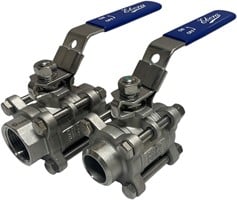
Ball Valve Open or Closed?
The handle position shows the valve status at a glance. When the handle is inline with the pipe, the valve is open. When the handle is perpendicular to the pipe, the valve is closed. This visual confirmation makes ball valves especially practical in installations where quick status checks matter.
Which Type of Ball Valve Do You Need?
Ball valves are available in three bore configurations, each with a different impact on flow and application:
| Type |
Bore |
Application |
| Full bore |
Same diameter as pipe |
Pigging, free flow required, minimal pressure drop |
| Reduced bore |
One size smaller than pipe |
Standard shut-off, space-saving, cost-effective |
| V-port |
V-shaped ball or seat |
Flow control, dosing, regulated opening |
A full bore ball valve has an oversized ball so the bore matches the pipeline diameter exactly — required when pigging is necessary or when pressure drop must be kept to a minimum. A reduced bore ball valve is the standard choice for most shut-off applications: compact, reliable and cost-effective. A V-port ball valve uses a V-shaped opening for more linear flow control and is suited to dosing or regulation, though less precise than a dedicated control valve.
Manual, Pneumatic or Electric — Which Actuation Fits Your Installation?
The choice of actuation depends on your operating conditions, control system and installation requirements. Use the overview below to select the right type, and follow the links to the corresponding product pages.
For pneumatic and electric ball valves, Ebora assembles and tests the complete valve-actuator combination in our Valve Automation Center — you receive a ready-to-install unit. For more information about actuator types and selection criteria, see the actuator page.
Materials: Metal or Plastic?
The choice of material depends on the medium, pressure, temperature and chemical compatibility.
Metal ball valves are available in:
- Brass — standard choice for water, gas and heating installations up to PN40
- Stainless steel (316) — for aggressive media, food-grade applications and high temperatures
- Cast iron / ductile iron — for larger diameters in water and steam systems
- Carbon steel — for high-pressure and high-temperature industrial applications
Plastic ball valves are available in PVC-U, PVC-C, PP, PE, PVDF, PTFE and PFA — used when chemical resistance is the primary requirement, for example in dosing systems, water treatment and the chemical industry. Plastic valves are not suitable for high temperatures or high pressures.
What to Specify When Selecting a Ball Valve
To select the correct ball valve, specify the following parameters:
- Medium (water, steam, gas, chemical, food-grade)
- Operating pressure (PN class)
- Operating temperature (°C)
- Pipe diameter (DN)
- End connection (threaded, flanged, welded)
- Actuation (manual, pneumatic, electric, bare shaft)
- Required certifications (ATEX, SIL, food-grade)
For applications involving aggressive media, high pressures or ATEX zones, contact our specialists for a tailored selection.
Ball Valves from Stock — Delivered Within Days
Ebora holds a broad range of ball valves in stock — including manually operated, pneumatic and electric versions. When the components are available, we assemble and deliver the complete valve within a few days. Select your ball valve by diameter, pressure class and actuation type, or request a quote directly for project quantities.
Frequently Asked Questions
What is the difference between a full bore and a reduced bore ball valve?
A full bore ball valve has a bore that matches the pipe diameter exactly, resulting in minimal pressure drop and unrestricted flow. A reduced bore ball valve has a bore one size smaller than the pipe, which is sufficient for most shut-off applications and is more compact and cost-effective.
When do I choose a pneumatic ball valve instead of an electric one?
Choose a pneumatic ball valve when fast switching is required, when compressed air is available in the installation, or when a spring-return failsafe position is needed in case of power failure. Choose an electric ball valve when the system is controlled by a PLC or BMS, when no compressed air is available, or when modulating control is required.
Can a ball valve be used for flow regulation?
A standard full bore or reduced bore ball valve is not suitable for throttling — it is designed for on/off shut-off only. Partial opening causes turbulence and accelerated seat wear. For flow regulation, use a V-port ball valve, a control valve or a needle valve.


