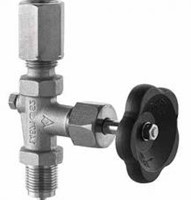
Why a Gauge Valve Instead of a Ball Valve?
In practice, a ball valve is often used directly before the pressure gauge. This seems a logical choice — ball valves are common, affordable and widely available — but for gauge applications, a ball valve is technically not the correct isolating device.
A ball valve opens fully in a quarter turn. This causes pressure to build up almost instantaneously at the measuring element. At higher working pressures, this sudden pressure build-up can damage the bourdon tube or measuring cell of the gauge, even if the peak pressure remains within the nominal range of the instrument.
A gauge valve uses a needle or spindle mechanism that allows you to open the flow path manually and gradually. You pressurise the gauge slowly and in a controlled manner. This prevents pressure shocks on opening and significantly extends the service life of the instrument.
Always choose a gauge valve when:
- You regularly isolate the gauge for maintenance or replacement
- The working pressure exceeds 10 bar
- The system is sensitive to pressure surges or pulsation
- Accurate readings are required and pointer oscillation must be avoided
A ball valve can still be used as a main isolating valve upstream of the gauge valve — for example to fully depressurise the section. The combination of ball valve and gauge valve provides both quick isolation and controlled pressure build-up on opening.
What Material Should You Choose for the Gauge Valve?
The material of the valve is determined by the medium and the ambient conditions. Ebora supplies in three standard materials:
- Brass – suitable for water, air and neutral gases at low to moderate corrosion loads
- Stainless steel – used for aggressive media, food applications or outdoor installations
- Carbon steel – for higher pressure classes in general industrial applications
Choose stainless steel when the medium is corrosive or when hygiene requirements apply. If you are unsure about the material selection, request technical advice via our product pages or contact us for a quote.
When Should You Use a Pressure Gauge Siphon?
A pressure gauge siphon — also known as a pigtail siphon or coil siphon — is used when the medium temperature is too high for direct connection to the gauge. This is typically the case with steam, hot water or other media above 60°C.
The siphon forms a loop in the pipe. Condensate collects in this loop, creating a liquid buffer between the hot medium and the gauge. Because heat transfer through this buffer is considerably lower than through metal alone, the temperature at the measuring cell remains within the permissible range of the instrument.
A siphon is therefore not an optional accessory in steam applications — it is a necessary protective measure to prevent premature wear or measurement errors.
Which Siphon Type Should You Choose?
Ebora supplies siphons in various shapes and sizes, matching the required process connection:
- U-type (straight) – compact design for limited space
- Pigtail / coil type – greater buffer capacity, better suited for higher temperatures
- Straight type – for specific mounting configurations
Siphons are available with various process connections (including G?, G¼, G½) and in materials such as brass and stainless steel. Match the type to the medium, temperature and available mounting option.
How Do You Protect Your Pressure Gauge Against Pressure Surges?
In systems where pressure surges occur — such as when starting pumps, operating quick-closing valves or using pulsating compressors — the measuring element of a gauge can be damaged by sudden pressure build-up. A pressure sensor is sometimes an alternative, but for gauge applications a pulsation damper is the appropriate solution.
When Is a Pulsation Damper Necessary?
A pulsation damper (snubber) is installed directly before the gauge. It is a fitting with a restricted orifice — a narrow bore — which slows down the pressure build-up at the measuring element. The peak pressure is dampened before it reaches the measuring cell. This extends the service life of the gauge and prevents reading errors caused by pointer oscillation.
Choose a pulsation damper when:
- The installation includes quick-closing valves or control valves
- A compressor or pump generates pulsating pressure
- You have previously experienced gauge damage in the same system
- Accurate readings are required and pointer movement impairs readability
Which Accessory Suits Your Application?
| Situation |
Recommended accessory |
| Maintenance or replacement of the gauge |
Gauge valve |
| Periodic calibration without pressure loss |
Valve with external test connection |
| Medium above 60°C (e.g. steam) |
Pigtail siphon |
| Limited space in steam application |
U-type siphon (compact) |
| Pulsating pressure or pressure surges |
Pulsation damper |
| Combination of high temperature and pressure surges |
Siphon + pulsation damper |
| Aggressive or corrosive medium |
Stainless steel version |
Use this table as an initial selection guide. When in doubt about the right combination — for example when high temperature and pressure surges occur simultaneously — it is advisable to apply both measures.
Fittings for Easy Installation
In addition to valves, siphons and dampers, Ebora supplies various fittings that simplify the mounting of your pressure gauge. These include reducing nipples, reducing rings and adaptor nuts for bridging size differences between the process connection and the instrument. These components are available in the common metric and BSP thread sizes.
Ebora supplies accessories from reputable manufacturers, including Wika, one of the leading producers in the field of pressure and temperature measurement.
Select the right pressure gauge accessories based on medium, temperature and process conditions, or request a quote directly via our product page.
Frequently Asked Questions
Can I combine a gauge valve with a siphon?
Yes, this is a commonly used combination in steam applications. You install the siphon directly on the process connection and the gauge valve between the siphon and the pressure gauge. This protects the instrument from both high temperatures and pressure build-up during maintenance.
What is the difference between a siphon and a pulsation damper?
A siphon protects the gauge against excessive temperatures by creating a liquid buffer. A pulsation damper protects against pressure surges by slowing down pressure build-up through a restricted orifice. Both serve a different purpose and can be used simultaneously.
For which media is a siphon not suitable?
A siphon is not suitable for media that solidify, crystallise or become viscous at lower temperatures. In such cases, the condensate buffer inside the siphon may become blocked, causing the protective function to be lost. In this situation, discuss which alternative protective measure applies.


