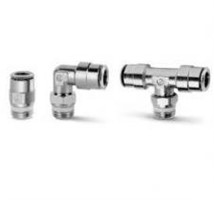
When do you use push-in fittings?
Push-in fittings are the most widely used connection method in pneumatics for connecting air hose up to approx. 12 mm outer diameter. The hose is inserted directly into the fitting — a collet grips the hose and creates an airtight seal. Removal is done by pressing the release ring. No tools required.
Important for selection: with push-in fittings, the outer diameter of the hose is the critical dimension for a secure connection. Use calibrated hoses for reliable sealing.
Push-in fittings are available in the following configurations:
- Straight — for inline connections
- Elbow (L) — for direction changes or restricted spaces
- T-fitting — for branch connections
- Reducer fitting — for two different hose diameters
- With male or female thread — for connection to fittings or valve manifolds
Choose the material based on your environment: plastic for standard pneumatics, brass for higher pressure or temperature, stainless steel for aggressive media or hygienic environments.
Push-in fittings for liquids
Standard push-in fittings with a single O-ring are suitable for compressed air. When used with liquids, leakage can develop over time as the hose puts increasing stress on the single O-ring. John Guest and Camozzi therefore supply push-in fittings with a double O-ring, specifically designed for liquid applications. The dual seal prevents this problem and ensures a durable, leak-free connection even under continuous liquid pressure.
Choose a push-in fitting with double O-ring when:
- You are working with water, coolant or other liquids
- The hose is continuously pressurised with liquid as the medium
- Leak-free operation is a requirement (process environments, laboratories, food industry)
Stainless steel push-in fittings from Ebora
Ebora supplies its own stainless steel push-in fittings under the Ebora brand — manufactured in 316 stainless steel and suitable for demanding industrial environments. When working with stainless steel valves, it is preferable to use stainless steel fittings as well. Although more expensive than standard nickel-plated brass or plastic fittings, they prevent galvanic corrosion and match the material choice of the system.
EBSS316CV — push-in fitting with check valve
The EBSS316CV is a stainless steel push-in fitting with an integrated check valve. When the hose is disconnected, the valve automatically closes off the compressed air supply. This prevents pressure drop in the system and increases safety during maintenance. Available as straight, elbow and T-fitting.
Choose the EBSS316CV when:
- Quick hose changes are required without venting the system
- The environment is corrosive or humid
- You are working with stainless steel valves where material consistency is important
Colour-coded stainless steel fittings for mixproof applications
For applications involving mixproof valves, Ebora has developed special stainless steel push-in fittings with an external colour-coded Viton O-ring. The colour-coded fitting is available in yellow, red, blue and white — both as an elbow and straight configuration. Combined with colour-coded PTFE hose, each circuit is immediately identifiable — a requirement in hygienic and pharmaceutical production environments.
Which fitting type suits your application?
| Type |
Application |
Material |
Advantage |
| Push-in fitting |
Pneumatics, hoses up to 12 mm |
Plastic, brass, stainless steel |
Fast assembly and disassembly |
| Push-in with double O-ring |
Liquids, water, coolants |
Plastic, brass |
Leak-free under continuous liquid pressure |
| Hose barb fitting |
Contaminated environments |
Brass, stainless steel |
Can be released even when contaminated |
| Quick coupling |
Frequently disconnected hoses |
Brass, hardened steel, stainless steel |
Air shut-off on disconnection |
| Threaded fitting |
Fixed pipework, manifolds |
Nickel-plated brass, stainless steel |
Universal, high pressure rating |
How do quick couplings work and when should you use them?
Quick couplings are used when hoses need to be disconnected regularly — for example on workshop tools, interchangeable machines or maintenance points. When the coupling is released, it automatically closes off the compressed air supply on the supply side.
Choose a quick coupling in hardened steel when the coupling is subject to mechanical stress, such as in workshop environments where couplings are regularly dropped. Hardened couplings are less susceptible to deformation and maintain their seal.
Where safety is a priority, the safety coupling is the right choice. When disconnecting a safety coupling, the other part does not fly off due to residual pressure — the system vents in a controlled manner before the coupling releases. This type is increasingly required in industrial environments.
For the luxury yacht industry, we supply safety couplings in polished stainless steel, suitable for both water and air. When disconnected, no water or air is released — ideal for on-board applications where leakage is not acceptable.
Threaded fittings for pneumatic pipework
The threaded fitting is the most universal connection for fixed pipework in pneumatic systems. Ebora supplies threaded fittings in the configurations commonly used for compressed air: straight, elbow and T-fitting, with BSP or metric thread.
Standard available in nickel-plated brass for dry compressed air and general industrial applications. Stainless steel versions are available for corrosive environments or applications involving cleaning with aggressive agents.
Important for selection:
- Use PTFE tape or liquid sealant on threaded connections to prevent leakage
- Check the thread standard (BSP or metric) before ordering — both are common in pneumatic systems
Do you have a specific application or need advice on which fitting suits your medium, pressure and hose diameter? Request a quote directly or contact our technical sales team for tailored advice.
Frequently asked questions
What is the difference between a push-in fitting and a quick coupling?
A push-in fitting connects a hose by simply inserting it, with the hose gripped by an internal collet. A quick coupling is designed for frequent disconnection and automatically closes off the compressed air supply on the supply side when released. Push-in fittings are more commonly used in fixed installations; quick couplings where connections are changed regularly.
When should I choose stainless steel fittings over brass?
Use stainless steel fittings in environments with corrosive media, cleaning agents, high humidity or hygienic requirements. Brass is suitable for dry compressed air in standard industrial environments. For the food or pharmaceutical industry, 316 stainless steel is the standard choice. Working with stainless steel valves? Then choose stainless steel fittings to prevent galvanic corrosion.
Which hose diameter should I specify when ordering push-in fittings?
With push-in fittings, the outer diameter of the hose is the determining dimension — not the inner diameter. The outer size must be specified for a correct fit. Use calibrated hoses for a reliable seal. With hose barb fittings, the inner diameter is the relevant dimension.


