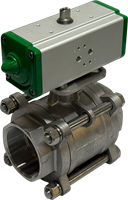
How does a pneumatic ball valve work?
A pneumatic actuator converts compressed air into rotary motion. The ball rotates exactly 90° between open and closed. In the open position the bore of the ball aligns with the pipeline: pressure drop is minimal and the medium flows unobstructed. In the closed position the bore is perpendicular to the pipeline and the valve seals leak-tight within the specified leakage class. The straightforward quarter-turn mechanism delivers consistent performance and high operational reliability, even at high switching frequencies and in wet or corrosive environments.
Single-acting or double-acting?
The choice between single-acting and double-acting determines the fail-safe behaviour and air consumption of your installation.
| Type |
Operation |
When to use |
| Single-acting |
Compressed air opens or closes; spring returns actuator on air loss |
Fail-safe required, safety-critical valves |
| Double-acting |
Compressed air for both opening and closing |
Fast cycles, high switching frequency, no fail-safe required |
A single-acting actuator with spring return moves the ball valve automatically to the required safe position (fail-close or fail-open) on air loss. This is the most common choice for process safety or emergency situations. A double-acting actuator uses compressed air in both directions and delivers a compact assembly with fast cycle times and lower peak torques.
Scotch yoke or rack-and-pinion?
Pneumatic actuators are available in two mechanical configurations: rack-and-pinion and scotch yoke. The mechanism determines the torque profile across the stroke. Rack-and-pinion delivers a consistent torque across the full 90° stroke and has a compact build. Scotch yoke peaks at break torque — precisely when the highest torque is needed — and delivers a lower run torque thereafter. This makes scotch yoke particularly effective in demanding applications with high break-out resistance.
Ebora's preferred configuration is scotch yoke, due to its robust construction, high peak torque at break and significantly lower compressed air consumption per cycle. Less compressed air means lower energy costs and reduced compressor load. In most Ebora configurations there is virtually no price premium over rack-and-pinion. Rack-and-pinion is supplied by Ebora on request or when the application specifically requires it.
Determining fail-safe behaviour
On air loss or emergency stop, the ball valve must move to a safe position. Determine early in the design whether this should be fail-close (closed on failure) or fail-open (open on failure) — this follows from your process design and safety analysis. A single-acting actuator with spring return achieves this mechanically, without reliance on external energy sources or electronics. The spring moves the actuator directly and reliably to the pre-set safe position. This makes pneumatic fail-safe actuators significantly less expensive to purchase than electric fail-safe variants with battery or supercapacitor backup.
Sizing torque and actuator correctly
Start with the valve data for break, run and seat torque under your process conditions. Correct for medium (lubricated or dry), pressure and temperature — dry or abrasive media require higher torque than lubricated liquids. Apply a safety margin of at least 25–30% and match the actuator to the available supply pressure. Typical operating pressures for pneumatic actuators are between 5 and 7 bar. Verify that the effective torque is sufficient in all positions — and particularly at break. After assembly, end stops, position indication and stroke are set and a function test is carried out.
Materials, seats and connections
Bodies are available in brass (water, compressed air, neutral media), stainless steel 316 (corrosive or hygienic applications) and plastics such as PVC or PP (chemically aggressive media within suitable pressure and temperature ranges). Seats are selected based on wear resistance, chemical compatibility and temperature; PTFE is the most widely used base material, with filled grades for higher load. Seals (EPDM, FKM, PTFE) follow medium and temperature. Connections are available as threaded (BSP or NPT), butt-weld or flange to DIN/EN or ANSI. Many ball valves are supplied as standard with an anti blow-out stem and anti-static provisions.
NAMUR, ISO 5211 and system integration
The actuator and ball valve are coupled via an ISO 5211 mounting pad. The drive shaft must match; an adapter or bracket is supplied where needed. NAMUR/VDI-VDE 3845 interfaces simplify the mounting of solenoid valves, limit switch boxes and position sensors in a standardised way. Via a NAMUR solenoid valve, the actuator is controlled electrically from your PLC or DCS without an electric motor on the actuator itself. A limit switch box or inductive sensors provide open/close feedback to your control system.
ATEX, TA-Luft and safety requirements
Pneumatic actuators are frequently used in hazardous areas (ATEX) because there is no electric motor on the actuator itself. This significantly limits ignition sources and EMC emissions. Actuators and accessories are available with ATEX options and appropriate enclosures. For ATEX applications, ensure correct air conditioning and select a solenoid valve with the correct ATEX category for your zone. Where required, our ball valves comply with TA-Luft or ISO 15848 for emission control; documentation is available. Actuators are optionally supplied with ATEX and SIL data for use in risk studies and functional safety analyses.
Applications by sector
Pneumatic ball valves are widely used in sectors with high demands on switching speed, process safety or area classification:
- Process water and utilities: frequent switching cycles in water treatment, cooling water and compressed air installations
- Oil, gas and petrochemicals: fail-safe behaviour with hazardous or flammable media, ATEX zones
- Chemical and tank storage: controlled remote operation, high operational reliability, low maintenance costs
- Food and pharmaceutical industry: stainless steel versions with hygienic design and traceability documentation
- HVAC and building services: fast zone isolation where compressed air is available
For applications without a compressed air supply or where precise modulating positioning is required, see the electric ball valves. If you want to operate manually for now with preparation for future pneumatic automation, a ball valve with bare shaft is the right choice.
Valve Automation Centre
Ebora assembles, configures and tests pneumatic ball valves in its own Valve Automation Centre. You receive a complete assembly — ball valve, actuator, solenoid valve, limit switch box and coupling — set up to your specifications. Test reports and full traceability documentation are available on request. No assembly is required on your end and you can be confident the combination functions correctly before commissioning.
Request advice or a quotation
Provide the following data with your enquiry: medium, pressure, temperature, required fail-safe behaviour (fail-close or fail-open), available supply pressure, required connection type (BSP/NPT, weld or flange) and whether ATEX or TA-Luft documentation is required. Also state the ball valve body material and ISO 5211 flange size. We will size the actuator, calculate the torque including margin and deliver the complete assembly fully tested.
Select the right pneumatic ball valve based on your process data or request a quotation via the contact page.
Frequently asked questions about pneumatic ball valves
Why does Ebora prefer scotch yoke over rack-and-pinion?
Scotch yoke peaks in torque precisely at break — the moment when the highest torque is required. The run torque then decreases, significantly reducing compressed air consumption per cycle compared to rack-and-pinion. In most Ebora configurations there is virtually no price premium. Less compressed air means lower energy costs and reduced compressor wear. Rack-and-pinion is supplied by Ebora on request.
Is a pneumatic ball valve suitable for ATEX hazardous areas?
Yes. Pneumatic actuators are specifically chosen for ATEX zones because there is no electric motor on the actuator itself. This limits ignition sources and EMC emissions. Actuators and accessories are available with ATEX certification. Ensure correct air conditioning and select a solenoid valve with the correct ATEX category for your zone classification.
How do I determine whether I need fail-close or fail-open?
This follows from your process design and safety analysis (HAZOP or SIL study). Fail-close means the valve closes on air loss or emergency stop — standard practice with hazardous or flammable media where closure is the safe state. Fail-open maintains flow on failure — for example in cooling water lines where blockage causes damage. Ebora advises on the correct choice based on your process data.
Can I control a pneumatic ball valve remotely from a PLC?
Yes. Via a NAMUR solenoid valve, the actuator is controlled electrically from your PLC or DCS. A limit switch box or inductive sensors provide open/close feedback. The ISO 5211 mounting and NAMUR/VDI-VDE 3845 interface make integration standardised and straightforward. Use filtered and regulated compressed air with sufficient flow capacity for maximum operational reliability.
What is the difference between a pneumatic and an electric ball valve?
A pneumatic ball valve uses compressed air as its energy source and has no electric motor on the actuator. This makes pneumatic actuation suitable for ATEX zones, wet environments and high switching frequency applications. Fail-safe is simple and cost-effective via spring return. An electric ball valve only requires supply voltage and is suited to modulating control and locations without a compressed air supply. The choice depends on your infrastructure, required switching speed and area classification.


