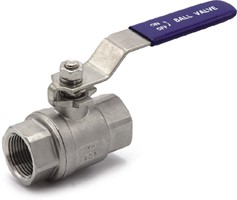
How does a manual ball valve work?
The stem connects the handle to the ball inside the valve body. In the open position, the bore of the ball aligns with the pipeline: flow passes unobstructed and pressure drop is minimal. A quarter-turn of the handle rotates the ball perpendicular to the pipeline, fully blocking flow and sealing the valve to the specified leakage class. An anti blow-out stem prevents the stem from being forced out of the body under pressure. Anti-static provisions limit spark generation when handling non-conductive media.
2-way or 3-way ball valve?
The choice between 2-way and 3-way depends on your process logic. A 2-way valve has one inlet and one outlet and is used for straightforward on/off isolation. A 3-way valve has three ports and an L- or T-bore, enabling you to divert, mix or distribute flow.
| Type |
Bore |
Application |
| 2-way |
Straight |
Opening and closing a single line |
| 3-way L-bore |
L-shaped |
Diverting: port A or B open, never both simultaneously |
| 3-way T-bore |
T-shaped |
Mixing or distributing: all three ports available simultaneously |
Choose the 3-way L-bore when switching between two lines. Choose the T-bore when mixing or distributing flow where simultaneous flow through multiple ports is required.
Handle or gearbox?
For smaller sizes up to approximately DN50, a lever handle is the standard actuation method: compact, direct and without additional components. As diameter or operating pressure increases, so does the required torque. In these cases, a gearbox (worm gear) is applied. A gearbox significantly reduces the required hand torque, enables operation in confined spaces and is suitable where the valve is operated regularly but not continuously.
Select a gearbox when:
- DN65 and above at higher operating pressures
- Limited space around the valve for handle operation
- Applications where a lever handle is unsafe or impractical
Note: a gearbox requires more turns than a direct lever and is therefore less suitable for emergency shut-off where speed is critical.
Materials and body selection
The body material is selected based on the medium and process environment. Brass is standard for water, compressed air and neutral media at lower pressures. Carbon steel (WCB or equivalent) is used in general industry for higher pressures and temperatures. Stainless steel 316 is selected for corrosive media, outdoor installation or hygienic applications in the food and pharmaceutical industries.
| Material |
Suitable for |
Not suitable for |
| Brass |
Water, air, neutral media |
- Strong acids, chlorine-containing media |
| Carbon steel |
General industry, higher pressure |
- Corrosive media, hygienic processes |
| Stainless steel 316 |
Corrosive, hygienic, outdoor installation |
- Strongly oxidising acids above concentration limits |
Selecting seats and seals
The seat determines the sealing performance and service life of the ball valve. PTFE is the most widely used seat material: chemically resistant, suitable for a wide temperature range and compatible with most media. Filled PTFE grades (glass fibre, graphite or carbon) are used under higher mechanical load or with abrasive media.
Seals are selected based on medium and temperature:
- EPDM: water, steam up to 140°C, not suitable for oils or fuels
- FKM (Viton): oils, fuels, higher temperatures up to approximately 200°C
- PTFE: broad chemical resistance, limited elasticity
PFAS-free configurations without standard PTFE-based seats are an emerging option for industries subject to PFAS regulations. Contact us for current availability.
Always provide the medium, temperature and maximum operating pressure when requesting a quote. We will select the correct seat and seal combination for your application.
Connections and standards
manual ball valves are available with threaded connections (BSP or NPT), butt-weld ends or flanges to DIN/EN or ANSI standards. The face-to-face dimension and pressure class match your existing pipework. For flanged versions, verify the PN class (PN6, PN10, PN16, PN25 or higher) and the drilling pattern standard. Lockable handles are available as an option for lock-out-tag-out (LOTO) procedures or where unintended operation must be prevented.
Typical applications
manual ball valves are used where local operation is sufficient and automation is not required:
- Utility lines: cooling water, compressed air, nitrogen and inert gas in production plants
- HVAC and water treatment: zone isolation, filling points and venting points
- Food and pharmaceutical industry: stainless steel configurations with PTFE seats for CIP cleaning
- Chemical industry: selection based on chemical and thermal resistance of body and seat
- Machinery and plant engineering: integration into skids and modules where compactness and simplicity are required
Planning to automate later?
If you already know the valve may need to be automated at a later stage, select a ball valve with bare shaft. A bare shaft version has an ISO 5211 mounting pad on top of the stem. A pneumatic or electric actuator can be fitted afterwards without replacing the valve body, preserving your investment while adding actuation only when needed.
If you require a fully automated solution now, see the electric ball valves for motor-driven remote operation or the pneumatic ball valves for compressed-air-actuated shut-off with fast switching cycles.
Request advice or a quotation
Provide the following process data with your enquiry: medium, pressure, temperature, required flow capacity (Kv/Cv), diameter, connection type (BSP/NPT, weld or flange) and whether you need 2-way or 3-way. Also specify whether you require a lockable handle, gearbox or ISO 5211 mounting pad for future automation. We will select the correct manual ball valve including seat, seal and options.
Select the right manual ball valve based on your process data or request a quotation via the contact page.
Frequently asked questions about manual ball valves
What is the difference between a manual (hand-operated) ball valve and a bare shaft ball valve?
A manual ball valve is actuated directly via a lever handle or gearbox and requires no external power source. A bare shaft ball valve has an ISO 5211 mounting pad on top of the stem onto which a pneumatic or electric actuator can be fitted at a later stage. The bare shaft version is a preparatory choice for future automation, not an actuation method in itself. If you already know automation will be required, select the bare shaft version from the outset.
Which material should I select for corrosive or hygienic media?
For corrosive media or hygienic applications, select a stainless steel 316 body with a PTFE seat. Verify that the seal material is chemically compatible with your medium and suitable for the operating temperature. If in doubt, provide the full media datasheet and temperature range and we will select the correct configuration.
Can I use a lockable handle for LOTO procedures?
Yes. Many manual ball valves are available with a lockable handle. This prevents unintended operation and supports compliance with lock-out-tag-out (LOTO) requirements. The lock is applied directly to the handle, allowing the valve to be mechanically secured in the open or closed position. Specify this requirement when placing your enquiry.
How do I select the correct pressure class for my application?
The pressure class (PN rating) defines the maximum allowable operating pressure at a given temperature. Common ratings are PN6, PN10, PN16 and PN25. Note that the allowable pressure decreases at higher temperatures. Always provide both the maximum operating pressure and the operating temperature so we can confirm the correct PN rating for your application.
Are PFAS-free ball valves available?
PFAS-free ball valves are an emerging category in which seats and seals are produced without PFAS-containing materials such as standard PTFE. This is relevant for industries where PFAS emissions or use are subject to regulation. We are following this development and are happy to advise on suitable configurations for your application. Contact us to discuss the options.


